Digital Signage vs Narrowcasting: this is the difference
You are looking for information about digital screen communication. Perhaps because you want to inform your visitors better, reach employees or show customers a more relevant message.
During your search, you will probably come across two terms:
Digital Signage and Narrowcasting.
But what exactly do these terms mean? Are they two different systems? Or are the same solutions simply called different things?
That confusion is completely understandable. The terms are regularly used interchangeably. Still, it is useful to understand the difference before approaching a supplier or requesting a quotation. Because ultimately, it is not about the name of the system. It is about choosing a solution that allows you to effectively reach your target audience with the right information, at the right time and in the right place.
Marcel Brinkhof, Account Manager at AVEX, hears this question regularly. With more than 20 years of experience in the audiovisual industry, he has seen both terms evolve and uses them daily in conversations with customers.
“What I often see is that people worry about using the right terminology, while in practice it is much simpler than they think. Let me explain.” Marcel Brinkhof Account Manager AVEX
In this article, you will read:
- What exactly Digital Signage is and what it includes.
- What Narrowcasting means and how it differs (or does not).
- Why both terms are used in the Netherlands.
- Which term you should use yourself.
- What to look out for when choosing a system (regardless of the term).
After reading, you will know exactly how Digital Signage and Narrowcasting relate to each other and which aspects are important when choosing a solution.
What is the difference between Digital Signage and Narrowcasting?
In short, Digital Signage is the umbrella term for digital screen communication. Narrowcasting refers to the targeted use of those screens for a specific audience in a specific location.
You can think of it like this:
- Digital Signage is about the technology behind digital screens.
- Narrowcasting is about how you use this technology to communicate in a targeted way.
In practice, the terms overlap significantly. That is why they are often used as synonyms.
An organisation that uses digital screens to inform employees, visitors or customers is technically using Digital Signage. When the message is tailored to a specific target audience, location or moment, we also refer to this as Narrowcasting.
What is Digital Signage?
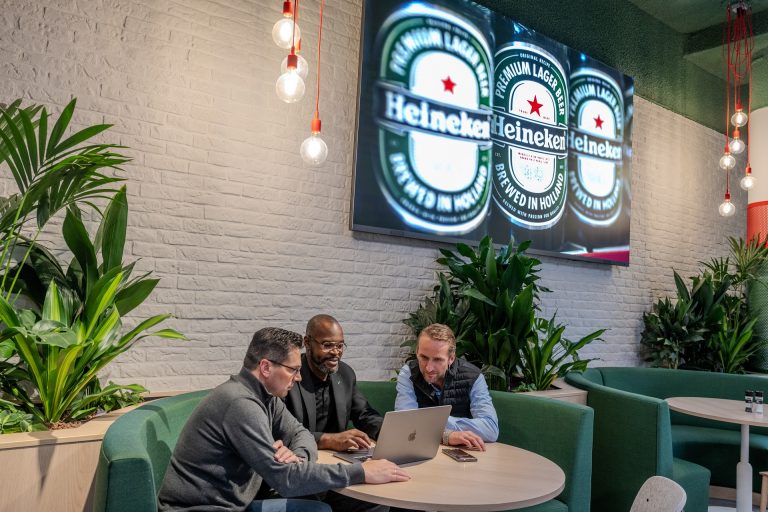
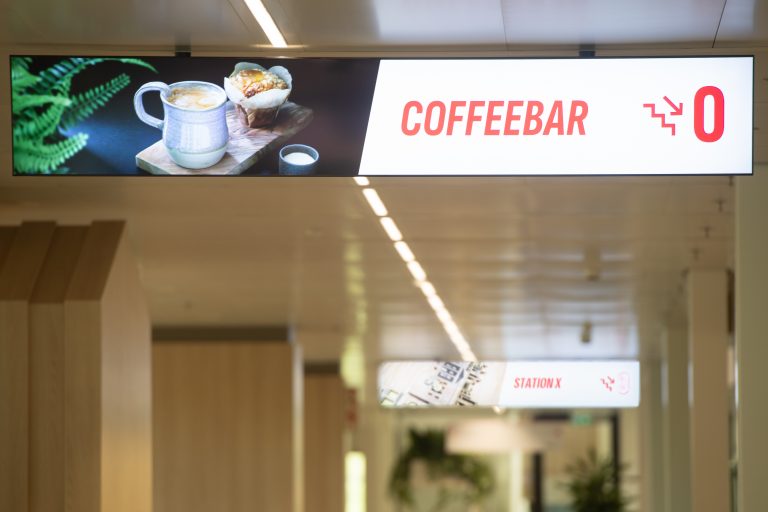
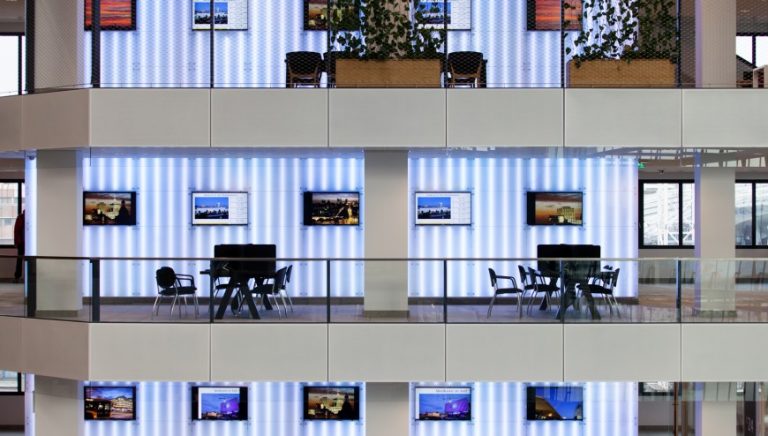
Digital Signage is the collective term for communication via digital screens. This could be a small information screen in a shop, but also a large LED wall in a station hall or the entrance of a large office.
When you choose a Digital Signage system, you are dealing with different components. Think of the screens themselves, the software used to manage content, the content being displayed and the infrastructure that ensures everything runs reliably.
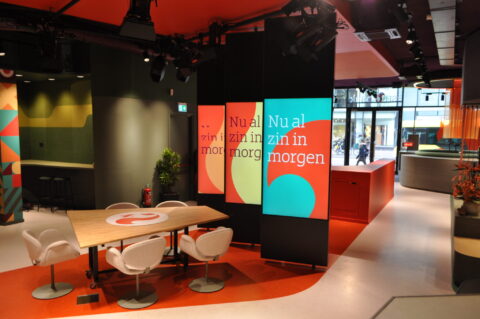
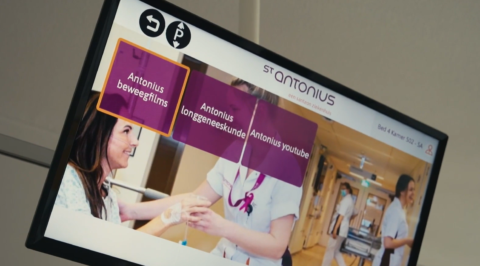
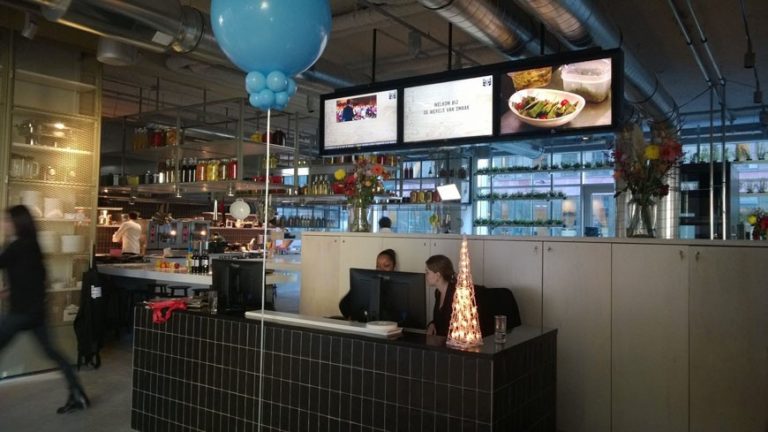
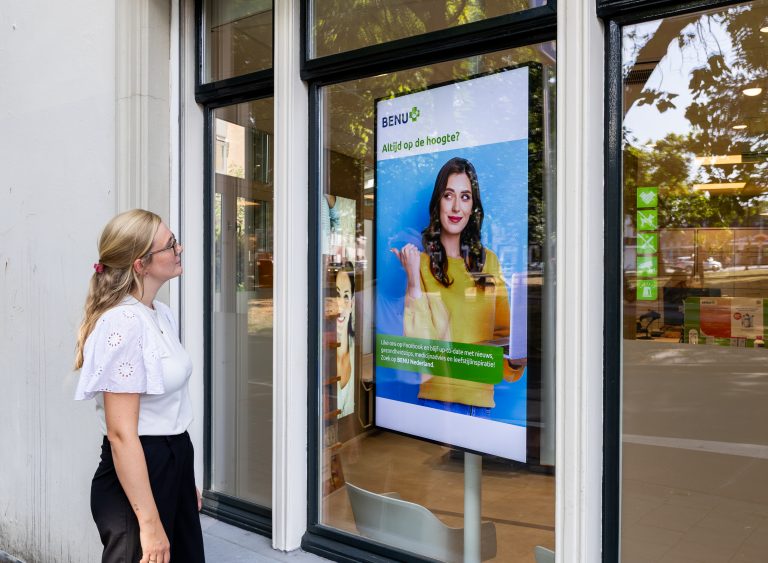
You see examples everywhere. Shop window screens displaying offers. Information screens in hospitals guiding visitors. Digital menu boards in restaurants. Internal communication screens in offices. Travel information screens at railway stations.
Digital Signage therefore describes the complete technical ecosystem used to communicate via screens.
What is Narrowcasting?
Narrowcasting is not a different system, but a way of communicating. The term is mainly used in the Netherlands. Internationally, people almost always refer to Digital Signage.
The word is derived from broadcasting, which means transmitting a general message to a broad audience. Narrowcasting is the opposite: a targeted message for a specific audience.
In practice, it is about showing relevant content in the right place and at the right time. Instead of one general message for everyone, you tailor your content to the location, time and target audience. A screen in the canteen shows different information from a screen at reception. What you communicate in the morning may differ from what you show later in the day. Visitors need different information from employees.
With Narrowcasting, the emphasis is less on the technology and more on the strategy behind the content. It is about relevance and targeted communication.
Difference between Digital Signage and Narrowcasting at a glance:
| Aspect | Digital Signage | Narrowcasting |
| Definition | Umbrella term for digital screen communication | Targeted use of screens for a specific audience |
| Focus | Technology and infrastructure | Strategy and targeting |
| Covers | Screens, software, content, network | Relevance of the message by location and time |
| Example | A network of screens in a hospital | Specific content in a waiting room tailored to patients |
| Is it a system? | Yes, it describes the complete system | No, it describes how the system is used |
| International term | Standard worldwide | Mainly used in the Netherlands |
| Overlap | Can exist without strong targeting | Almost always uses Digital Signage technology |
The difference explained
The difference between Digital Signage and Narrowcasting is smaller than many people think.
In practice, almost every professional Digital Signage solution is also a form of Narrowcasting. Organisations use digital screens almost always with a purpose: to share a specific message with a particular target audience.
Digital Signage is the tool.
Narrowcasting is how you use that tool effectively.
They are therefore not two different systems, but two different perspectives.
Why are both terms used?
The fact that both terms exist side by side is mainly related to the history and context in which they are used.
In the Netherlands, Narrowcasting was the term used most often for many years. The emphasis was on communicating in a targeted way with a specific audience.
Internationally, Digital Signage has now become the standard term. Anyone looking for solutions, software or suppliers outside the Netherlands will almost always encounter this term.
Suppliers also regularly use both terms, but often with a slightly different emphasis:
- Digital Signage is often used when referring to the technical solution, such as screens, software and management.
- Narrowcasting is more often used when referring to communication, content strategy and targeted information.
Search behaviour also plays a role. One organisation may search for Digital Signage software, while another searches for a Narrowcasting solution.
Both search terms ultimately often refer to the same type of solution: digital screen communication that helps organisations share information effectively.
Which term should you use?
If you are looking for a solution yourself, Digital Signage is the most future-proof term. Why? Because Digital Signage is used internationally and aligns well with the complete solution: from hardware and software to management and content.
That does not mean Narrowcasting is the wrong term. This term is still widely used and virtually every supplier will understand what you mean.
The most important thing is therefore not which term you choose, but that your organisation is clear about what you want to achieve with the solution.
For example, ask yourself these questions:
- Who do you want to reach with your communication?
- What information do you want to share?
- At which locations do you want to use screens?
- Who will manage the content?
- How do you ensure that the information remains up to date?
A good Digital Signage system or Narrowcasting solution does not start with the screen, but with the purpose behind the communication.
What should you look for when choosing a system?
Whether you are looking for a Digital Signage system or a Narrowcasting solution, ultimately it is not about the name.
It is about whether the system helps your organisation communicate better.
When choosing a solution, these points are particularly important:
Ease of use
Scalability
Content support
Remote monitoring
Proven success stories
Checklist: how to choose the right solution
Before purchasing a Digital Signage system, it is advisable to answer these questions:
- Is the system easy for my team to use?
- Can the solution grow with my organisation?
- Is support and training available?
- Can issues be resolved remotely?
- Is support available for creating effective content?
- Does the supplier have experience within my industry?
At AVEX, we offer complete solutions – from the initial assessment to installation, content creation, monitoring and maintenance. Whether you call it Digital Signage or Narrowcasting, what matters is that it works.
It does not matter what you call it – what matters is that it works
The question of whether you should use the term Digital Signage or Narrowcasting may seem important, but ultimately the term is less relevant than the solution itself.
Both terms refer to the use of digital screens to make communication more effective.
The most important thing is that you choose a system that:
- reaches your target audience;
- displays relevant information;
- is easy to manage;
- works reliably.
Because a screen alone does not make communication better.
It is about the combination of technology, strategy and content.
AVEX helps organisations with digital screen communication that works
At AVEX, we have been helping organisations with audiovisual solutions that contribute to better communication for more than 35 years. Whether you call it Digital Signage or Narrowcasting, we look at what your organisation needs. From assessment and advice to installation, content creation, monitoring and support. This ensures that digital screens do not just hang there, but actually add value.
Our solutions are used by organisations such as BENU Pharmacies, NBC Congrescentrum, Randstad and NS. Because ultimately, it is not about the technology. It is about reaching people with the right message, at the right time.

Marcel Brinkhof
Account Manager

Publication date
17 February 2026
Updated date
24 August 2026
Sector
All Sectors, Central Government, Culture, Sports & Recreation, Education, Financial & Professional Services, Government, Healthcare, Hospitality, Local Government, Public Safety & Security, Retail, Trade & Industry
Solution
Digital Signage, Wayfinding
Keep discovering